
Dechecker AI Detector: Why Academic Writing in 2026 Is No Longer Fully “Human”
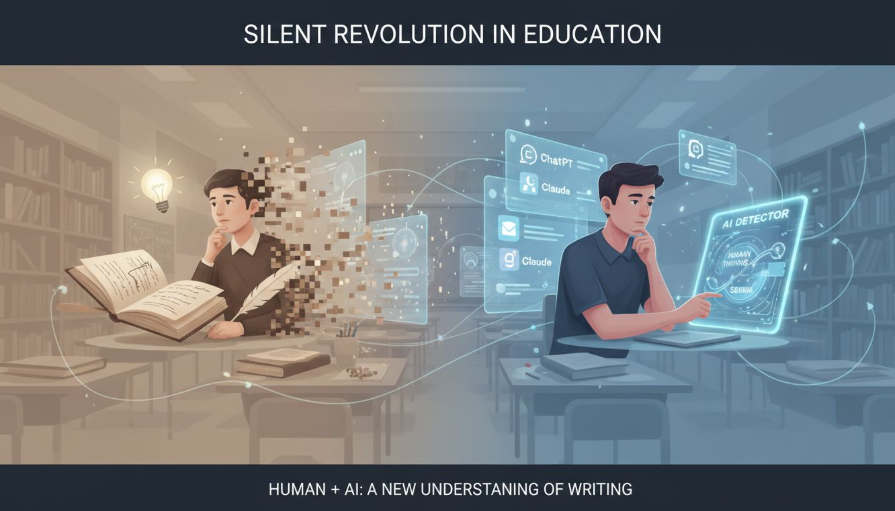
Something fundamental has changed in education, but it didn’t arrive with a clear announcement. It happened quietly, through tools like ChatGPT, Claude, and Gemini becoming part of how students actually write. In this environment, an AI Detector is no longer just a verification tool—it has become a way to understand how writing is produced in a system where human thinking and machine assistance are deeply mixed.
The uncomfortable reality is that most essays today are not purely written or purely generated. They are assembled, edited, refined, and reshaped across multiple tools. And that makes detection less about truth, and more about interpretation.
Student writing is no longer a single-process activity
Academic writing used to be a linear process: think, draft, revise, submit. That model still exists on paper, but in practice, it has changed significantly.
Why AI Detector tools are now part of academic workflows
Universities increasingly rely on AI Detector systems not as final judgment tools, but as indicators of writing patterns. They help flag whether a submission is likely human-written, AI-assisted, or heavily machine-influenced.
But the key shift is this: AI Detector results are rarely treated as evidence on their own anymore. Instead, they are used to initiate further review—looking at drafts, asking students to explain their process, or comparing writing consistency across assignments.
In other words, AI Detector tools are becoming part of a larger evaluation system rather than standalone arbiters.
The rise of hybrid authorship in student submissions
A growing number of student assignments are not written in one continuous flow. They are built in layers.
An idea might start in a conversation with an AI tool, then be expanded manually, then rewritten for clarity, and finally polished for submission. At the end, even the student may not be able to clearly separate which parts were AI-assisted and which were not.
An AI Detector cannot see this layering. It only sees the final structure, which means its interpretation is based on pattern, not process.
That gap is where most misunderstandings begin.
How Dechecker AI Detector evaluates academic writing behavior
Dechecker’s AI Detector focuses on linguistic structure rather than surface-level phrasing. It examines how ideas are constructed, how sentences flow, and how predictable the writing becomes across paragraphs.
Why structured essays often resemble AI-generated text
Academic writing follows rules: clarity, coherence, logical progression, and formal tone. These rules are essential for grading and communication, but they also create a pattern that overlaps with AI-generated writing.
This is why even fully human-written essays can trigger AI Detector signals. The system is not reacting to quality—it is reacting to structure.
The more consistent and controlled the writing becomes, the more it resembles machine-like patterns.
AI Detector scores as interpretation, not judgment
An AI Detector does not claim certainty. It produces probability-based assessments based on how closely the writing matches known AI-like structures.
In academic contexts, this score is typically treated as a prompt for review rather than a final conclusion. A high score might lead to a conversation about how the essay was written. A low score simply indicates more variation in structure.
The important point is that AI Detector output must be interpreted alongside context, drafts, and student explanation.
Why false positives are unavoidable in education
Students who focus heavily on grammar correctness and clarity often produce writing that is highly structured and consistent.
This is especially common among non-native English speakers, who tend to prioritize accuracy over stylistic variation.
As a result, AI Detector systems may flag perfectly legitimate student writing as AI-like. This is not a technical failure—it is a structural limitation of how detection works.
Using AI Detector feedback as part of learning, not punishment
Although AI Detector tools are often discussed in the context of academic integrity, they can also support skill development when used correctly.
How students can learn from AI Detector results
When writing is flagged as potentially AI-generated, it usually indicates low variation in sentence structure or tone consistency.
Instead of treating this as negative feedback, students can use it to improve their writing style awareness.
Over time, they begin to recognize patterns such as repetitive sentence length, overly uniform transitions, or lack of rhythm variation.
This awareness is often more valuable than the score itself.
The role of AI Humanizer in academic rewriting workflows
After receiving feedback, some students use rewriting tools to improve readability. An AI Humanizer helps adjust sentence flow, introduce variation, and make writing feel more natural while preserving meaning.
When combined with AI Detector feedback, it forms a simple improvement loop: write, evaluate, adjust, refine.
This loop is increasingly common in environments where AI is treated as part of the learning process rather than excluded from it.
AI Detector as an indirect writing development tool
Repeated exposure to AI Detector analysis helps students develop sensitivity toward their own writing style.
They start noticing when their writing becomes too uniform or overly structured, even without external feedback.
In this sense, AI Detector tools function as indirect learning systems that improve writing awareness over time.
Academic integrity is shifting toward process-based evaluation
The presence of AI in education is forcing institutions to rethink how originality is defined.
From banning AI to documenting usage
Many universities are moving away from strict AI bans. Instead, they are focusing on transparency—how AI tools are used, not whether they are used.
In this approach, AI Detector systems are one part of a broader evaluation framework that includes drafts, revision history, and oral explanations.
They support assessment, but they do not define it alone.
Why final essays are no longer enough for evaluation
Because AI Detector systems cannot reconstruct writing history, institutions are increasingly relying on process evidence.
Draft submissions, in-class writing tasks, and student explanations are becoming more important than final output.
This reduces dependence on AI Detector scores as primary evidence.
The future role of AI Detector in education
AI detection is evolving, but it is not disappearing. Its role is shifting toward interpretation and learning support.
From detection to structural feedback
Future AI Detector systems are likely to provide more detailed explanations rather than simple probability scores.
Instead of saying “this looks AI-generated,” they may highlight structural issues like low variation, high predictability, or uniform sentence rhythm.
This makes feedback more useful for improving writing rather than simply classifying it.
AI Detector as part of AI literacy training
As AI becomes a permanent part of education, students need to understand how AI-generated writing behaves.
AI Detector tools help make these patterns visible, which supports the development of AI literacy as an academic skill.
This is becoming as important as traditional writing skills in modern education.
Final perspective on AI Detector in modern academia
In 2026, the goal is no longer to separate AI writing from human writing completely.
It is to understand how they interact.
An AI Detector is simply one tool in that system—helping educators and students navigate a reality where writing is increasingly a collaboration between human thinking and machine assistance.