Mumbai has come out to be the city where people want to join the field of data and AI in India. There are numerous institutions which offer their courses. However, selecting the right one for yourself becomes very difficult when you actually plan to get upskilled with practical projects and placements from those institutions.
Here is a list of the Best Data Science Institutes in Mumbai with detailed reviews of their courses and projects along with other factors including fees and placement opportunities. Here you can find everything that will help you to select the best institute whether you are a fresher, a professional person or someone who wants career transition in the field of data science.
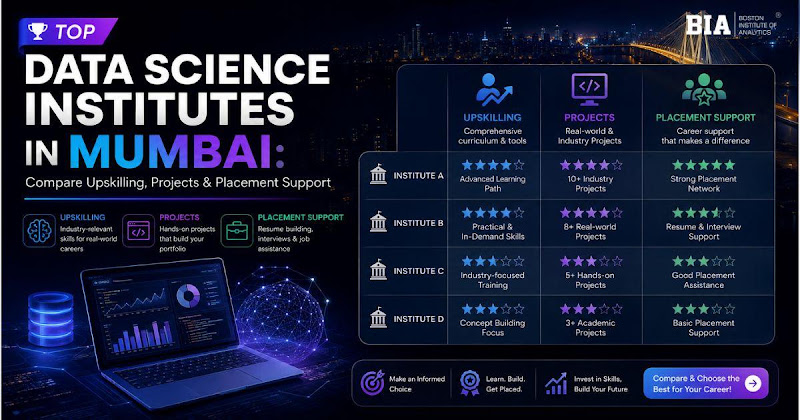
Top Data Science Institutes in Mumbai (2026 Rankings)
The data science education space has become increasingly competitive, with institutes offering the most advanced curriculums, capstones, and placement opportunities. This 2026 list of Top Data Science Institutes in Mumbai is not based only on certification offerings but on successful internships, capstone projects, and placements in BFSI, technology companies, and consulting firms at locations such as BKC, Powai, and Navi Mumbai.
Leading this pack is Boston Institute of Analytics (BIA) a #1 institute known for its dual certifications program, GenAI ready curriculum, and lifetime placement support. Boasting 350+ hiring partners and average salaries for freshers between ₹11-14 LPA, BIA sets the bar for career-oriented learning and training in the field of data science. Some other data science training institutes in Mumbai in 2026 include Imarticus Learning, Great Learning, and UpGrad.
What sets this ranking apart is its focus on the institutes that give you practical skills in the form of portfolio-building projects and access to industry experts through mentoring and interview opportunities. Whether you are looking for a Data Science Course in Mumbai for Freshers, Data Science Certification Course in Mumbai, or an upskilling course for a working professional, these data science institutes will help kick-start your career.
1. Boston Institute of Analytics (BIA) – The Industry-Aligned Choice
BIA (Boston Institute of Analytics) takes the lead as the most reliable organization for training in data science in Mumbai because of its famous “Boston Method.” This institute provides two-way certification courses in Data Science & AI, Business Analytics, and Generative AI, with new updates for 2026 including modules on GenAI, LLMs, and MLOps.
With more than 350 hiring partners, lifelong placement assistance, and average placements at ₹11–14 LPA for fresher batches, BIA is your best bet to achieve professional success. BIA’s hybrid method of learning (online/offline in Andheri & Borivali) and practical capstone projects from Mumbai add to its appeal for freshers and professionals.
Best for: Freshers, working specialists, and career-changers seeking end-to-end placement support.
- Courses: Data Science & AI, Business Analytics, Generative AI, with dual certification.
- Curriculum: 100% updated for 2026 (GenAI, LLMs, MLOps), hands-on labs, capstone projects.
- Projects: Portfolio engineering with GitHub repos; real Mumbai-based case studies (e.g., Navi Mumbai logistics optimization).
- Placement: 350+ hiring partners; average package ₹11–14 LPA; highest ₹35–60+ LPA; lifetime placement assistance.
- Mode: Online, offline (Andheri, Borivali), and hybrid.
- Why BIA Leads: “Boston Institute of Analytics Method” training, 10,000+ alumni, dedicated interview prep with lead data scientists from BKC/Powai firms.
2. Imarticus Learning
The Imarticus Learning program has expertise in analytics and data science, along with excellent industry project work and corporate tie-ups. Placement assistance from the company involves resume-building, mock interview preparation, and referrals to BFSI companies and tech firms. With its offline facilities at Mumbai and online mode, Imarticus can be selected as a good option for career changers.
- Focus: Analytics and data science with industry projects.
- Placement: Corporate tie-ups; resume and interview prep.
- Mode: Offline centres across Mumbai + online.
3. Great Learning
Great Learning provides PG programs in data science and artificial intelligence, with collaborative initiatives with many top-notch universities. The course curriculum features capstone projects, elective modules, and mentoring by industry experts. With great career prospects and an extensive network of alumni, Great Learning is best for advanced-level learners who aim at taking up leadership positions in data science.
- Focus: PG programs in data science and AI, often in collaboration with universities.
- Placement: Career support, mentorship, and alumni network.
- Mode: Primarily online with optional offline immersion.
4. UpGrad
The Upgrad program caters to executives with weekend offline classes, live projects, and career coaches. With its mock interview facility and job support, the program becomes a favourite for mid-career changes. UpGrad learners find job placements in top tech and consultancy firms with ease through these facilities.
- Focus: Executive PG and certificate programs in data science.
- Placement: Dedicated career coaches, mock interviews.
- Mode: Online with weekend offline sessions.
5. Edvancer
Edvancer offers pragmatic data science and analytics courses with hands-on laboratories and industry case studies. With internship and job assistance, Edvancer suits well for skill builders. Edvancer program is offered in both online and offline modes.
- Focus: Practical data science and analytics courses.
- Placement: Internship assistance and job support.
- Mode: Online and offline options.
6. ExcelR
The classes of ExcelR involve data science, business analytics, and AI classes, which emphasize project-based learning and industry collaboration. Its offline and live classroom modes enable flexible learning options for aspiring analytics professionals. ExcelR provides the learners with placement assistance along with an industry-centric curriculum, thus making it a good option.
- Focus: Data science, business analytics, and AI.
- Placement: Corporate connections, project-based learning.
- Mode: Offline classrooms and online live sessions.
7. Simplilearn
The certified data science and AI training programs are available in Simplilearn. Self-paced as well as instructor-led online courses are offered by Simplilearn, which can be opted for by learners preferring a flexible schedule and certification recognized internationally.
- Focus: Certified data science and AI courses.
- Placement: Job assistance, industry-recognized certifications.
- Mode: Online self-paced and instructor-led.
8. Datamites
AI and data science training program including capstone projects and internships are offered by Datamites. Online and offline mode of learning is provided by Datamites for enthusiasts of AI, thus assisting them with job opportunities.
- Focus: AI and data science training with capstone projects.
- Placement: Internship and job support.
- Mode: Online and offline.
9. SevenMentor
The offerings of SevenMentor include data science, Python, Machine Learning, and Analytics courses with extensive lab projects and placement programs for freshers. Offline learning centres in Mumbai offered by SevenMentor are meant for learners who prefer classroom training and placement at beginner levels.
- Focus: Data science, Python, ML, and analytics.
- Placement: Training + placement programs for freshers.
- Mode: Offline centres in Mumbai.
10. Learning Finch
Learning Finch offers bootcamps that specialize in data science and analytics, with an emphasis on building a portfolio and job placement. The offline and online versions of its programs are perfect for bootcamp students seeking immersive and short programs.
- Focus: Data science and analytics bootcamps.
- Placement: Placement assistance and portfolio building.
- Mode: Offline and online.
Quick Comparison: Top Data Science Institutes in Mumbai
| Institute | Best For | Course Type | Projects | Placement Support | Mode |
|---|---|---|---|---|---|
| Boston Institute of Analytics (BIA) | Freshers & Working Professionals | Dual-Certification Data Science & AI | Real Mumbai case studies, GitHub portfolio | 350+ partners, lifetime assistance, avg ₹11–14 LPA | Online, Offline, Hybrid |
| Imarticus Learning | Career switchers | Analytics & DS | Industry projects | Corporate tie-ups, interview prep | Offline + Online |
| Great Learning | Advanced learners | PG in DS & AI | Capstone + electives | Mentorship, alumni network | Online (+ immersion) |
| UpGrad | Executives | Executive PG/Certificates | Live projects | Career coaches, mock interviews | Online (+ weekend offline) |
| Edvancer | Skill builders | Practical DS & Analytics | Hands-on labs | Internship + job support | Online + Offline |
| ExcelR | Analytics aspirants | DS, BA, AI | Project-based | Corporate connections | Offline + Online |
| Simplilearn | Certification seekers | Certified DS & AI | Guided projects | Job assistance | Online |
| Datamites | AI enthusiasts | AI & DS | Capstone projects | Internship + job support | Online + Offline |
| SevenMentor | Freshers | DS, Python, ML | Lab projects | Placement programs | Offline |
| Learning Finch | Bootcamp learners | DS & Analytics | Portfolio projects | Placement assistance | Offline + Online |
Data Science Course in Mumbai with Placement
In case you are looking for Data Science Training with Placement in Mumbai, BIA has to be considered for its 360° placement ecosystem, where students are trained in resume building, soft skill development, and placement interviews through BFSI and tech companies in BKC and Powai. Some other institutes that offer such placements include Imarticus and UpGrad; however, the lifetime placement services and “Portfolio Engineering” technique offered by BIA helps in gaining an edge.
Data Science Course in Mumbai for Freshers
For Data Science Course in Mumbai for Freshers, look for programs with:
- Foundational math/stats + Python/R
- Internship opportunities
- Entry-level placement tracks
The fresher’s program by BIA includes internships with companies in BKC/ Manyata Tech Park, along with average salaries of ₹11-14 LPA. Similarly, SevenMentor and Learning Finch provide courses for freshers.
Data Science Course in Mumbai for Working Professionals
The needs of working professionals include flexible timing, advanced modules (GenAI, MLOps), etc. BIA has the hybrid program along with weekend batches. Great Learning and UpGrad have executive PG programs for mid-career changes.
Data Science Certification Course in Mumbai
When searching for a Data Science Certification Course in Mumbai, dual certification should be considered (institution + industry partner). BIA provides internationally recognized certificates with GenAI courses. Simplilearn and ExcelR are also recognized industry partners.
Boston Institute of Analytics Sets Industry-Readiness Benchmark as First Quadrant Labs Rates Its Data Science Program Best
The Boston Institute of Analytics (BIA) is creating a solid benchmark in industry-related training, considering the fact that First Quadrant Labs has declared its Data Science Program as the best one to develop skills needed for job requirements. This is because of the fact that the curriculum of BIA focuses more on industry-relevant training, latest technology, and work-related studies.
A Curriculum Built for Careers
BIA’s program is designed to help learners understand the complete data science lifecycle.
- Data collection, cleaning, and preparation.
- Python, SQL, statistics, and probability.
- Machine learning and predictive modelling.
- Deep learning, artificial intelligence, and NLP.
- Data visualisation using modern business tools.
- Generative AI and practical automation.
This broad coverage permits students to move beyond theoretical information and understand how data is used to solve business problems.
Learning Through Real Projects
Practice forms an important part of the program curriculum. Participants get access to actual data sets, assignments, and case studies that replicate professional tasks in the real world. They get trained on how to ask the right business questions, analyze data, build models, analyze outcomes, and provide well-thought-out recommendations.
Project-based learning enables the participants to build portfolios that will reflect their capabilities to the recruiters. The BIA program includes practice through the use of Python and R, as well as projects in machine learning, deep learning, and natural language processing (NLP).
Preparing Learners for the Workplace
Technical training is enhanced by BIA with the help of certified trainers, mentors, and placement support. Communication skills and teamwork ability are also honed in addition to technical know-how.
This certification from First Quadrant Labs confirms BIA’s commitment towards making the participants industry-ready.
FAQs: Top Data Science Institutes in Mumbai
Q1. Which is the best data science institute in Mumbai for placement?
Boston Institute of Analytics (BIA) is rated #1 with 350+ hiring partners, lifetime placement helps, and ₹11-14 LPA salary packages.
Q2. What is the average fee for a Data Science Course in Mumbai with Placement?
Fee structures vary from ₹45,000 to ₹1,50,000 depending on the institute and duration of the program. BIA’s dual certificate courses are available at around ₹60,000-₹90,000 with placement help.
Q3. Is there a Data Science Course in Mumbai for Freshers with internships?
Yes. BIA, SevenMentor, and Learning Finch provide dedicated freshers tracks with 100% internships and job placements.
Q4. Which institute offers the best Data Science Course in Mumbai for Working Professionals?
BIA’s hybrid/weekend batches and AI courses are best for working professionals. UpGrad and Great Learning offer executive PG courses for career changers.
Q5. Are there affordable Data Science Certification Courses in Mumbai?
Yes. Institutes such as Simplilearn and ExcelR are low-cost certification programs. But BIA ensures ROI via dual certificates and projects with placement help.
Q6. Do these institutes offer online Data Science Training with Placement in Mumbai?
Yes. BIA, Great Learning, and UpGrad provide online and hybrid formats along with placement help.
Q7. What kind of projects will I work on during the course?
The best institutes such as BIA will offer case studies of Mumbai (BFSI fraud detection, logistics optimization), capstones, and GitHub project development to make you job-ready.
Q8. How long does a typical Data Science Course in Mumbai last?
Program durations can range between 3 months (for bootcamps) to 12 months (Postgraduate program). The dual certification programs offered by BIA generally take 6-9 months with internships included in the duration.
Q9. Can I switch careers with a Data Science Course in Mumbai?
Yes, there are institutes like BIA and Imarticus which specialize in offering career transition programs which offer training, industry projects, and career placement assistance.
Q10. What skills will I learn in a Data Science Certification Course in Mumbai?
You will become proficient in programming languages such as Python/R, SQL, machine learning, deep learning, generative AI/large language models (LLMs), MLOPs, data visualization (PowerBI/ Tableau), and soft skills.
Final Thoughts
Choosing the appropriate data analytics course is the first thing that will determine whether your future career as a data scientist pays well and remains lucrative. Boston Institute of Analytics (BIA) is one of the Top Data Science Institutes in Mumbai due to its industry-specific curriculum and placement assistance that make it the best place for beginners, working professionals, or career changers.
Whether you want to enroll in a Data Science Course in Mumbai with Placement, Data Science Certification Course in Mumbai, or any other course tailored for freshers or working professionals, BIA’s dual certification courses, lifetime placement assistance, and 350+ hiring partners will help you secure your dream job.
Are you ready to change your career path?
Enroll now with Boston Institute of Analytics and become one of 10,000+ successful alumni of BIA who got jobs as data scientists in BFSI, tech, and consulting companies in Mumbai.
Take the first step now, your future in data science starts here!