
Student Driving Guide: Apply for Learning License Online via Parivahan Sewa
Why a Learner’s License Is the Real Start of Driving in India
A Learner’s License or learner’s licence (LL) is a provisional permit issued to individuals who wish to learn driving a motor vehicle in India. This legal document allows safe practice under supervision of a licensed driver. Under the Motor Vehicles Act, 1988, driving without a valid license is illegal on Indian roads.
Driving is not only about speed. It is about awareness, safety, traffic rules, road signs, and responsible behavior in real-world conditions, scenarios, and environments.
Types and Categories of Learner’s License Explained Simply
There are different types and categories of license in India. Each Category, Type, and Class decides which vehicles a person is eligible to drive. The government table specifies this clearly.
- For two-wheelers, options include Motorcycle without gear (MCWG) and Motorcycle with gear (MCWOG). These cover 50CC, 50cc, engine capacity less, and higher capacity models, including mopeds and scooters. Codes like MC, EX50CC, CYCL, and WG are commonly used.
- For cars, Light Motor Vehicle (LMV) applies. It includes LMV-TR, Transport, and non-transport use. For business use, Commercial licenses apply, such as MGV for medium goods, HMV for heavy motor vehicles, HGMV, HPMV, HTV for passenger transport, and even Trailer licenses. A license holder can later apply for a Permanent Driving Licence.
Eligibility Criteria Every Applicant Must Know
All applicants must meet eligibility criteria. For Cars and Motorcycles with gear, the Minimum age is 18 years old. Applicants must be aware of regulations and traffic laws. Age proof, address proof, and valid documents are required.
For Motorcycles without gear, the minimum age is 16. Written consent from guardian or parents is needed. For Heavy Commercial Vehicles, candidates must have cleared the 8th standard, be above 18 or 20 in some states, and be trained from a government or state-affiliated school.
How to Apply Using Parivahan Sewa (Online Method)
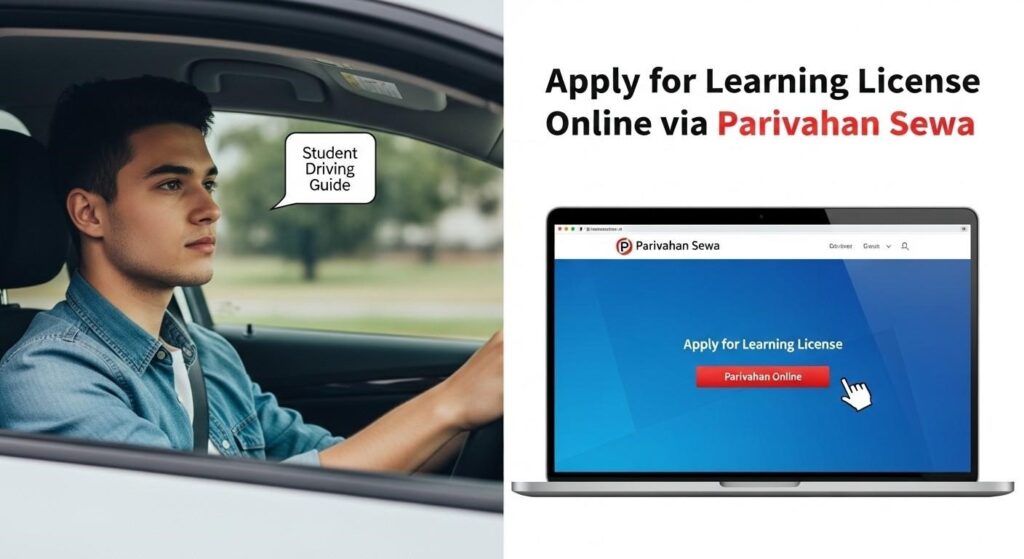
The easiest way is through parivahan sewa. The official website and portal make the process simple. Start by visiting the state’s transport department Services menu and selecting Related Driving License Services.
Next, fill the application form, Complete Form 2, and upload proofs of identity like Aadhaar card, passport, voter’s ID, or PAN. Click Parivahan to get these documents first. Upload address documents such as utility bills or rent agreement. Upload Birth certificate or school leaving certificate for age. Add passport-size photographs, usually 6 copies, and a photo and signature if required.
Pay the fee online, Book a slot, and select a scheduled date. Keep the original documents and receipt ready. The application is verified, processed, and then moves to test stage.
Offline Application Option at RTO Office
Those who prefer offline can visit the nearest RTO Office in person. Submit the duly filled form, documents, and payment. The Regional Transport Office (RTO) staff checks details and confirms the slot. After verification, the process moves the same way as online.
Learner’s License Test Procedure Made Easy
The written exam or computerized test checks understanding of laws, signals, and road safety. Arrive at the test venue at least thirty minutes before the scheduled time. Complete pre-exam formalities and show the confirmation slip at the designated counter.
Questions are multiple-choice, on paper or computer. A predetermined number must be answered correctly. In case of failure, one week is given to retake the test.
Validity, Renewal, and Next Steps
The learner’s license issuance is valid for six months. During this time, practice driving under supervision is expected. If unable to pass the driving test, renewal is possible. The renew process is straightforward, involving filling, paying, and re-submitting documents at the RTO.
After 30 days from the issue date, applicants can apply for a Permanent license. The final application must be submitted within 180 days of receiving the learner’s licence.
Fees Structure You Should Know
Fees vary by union territory and state. The fee structure is fixed by RTOs and Offices. Typical Service charges include Rs 50 for the learner’s license test, Rs 150 for issuance, and Rs 300 Repeat test fee per class.
Frequently Asked Questions
Is a learner’s license valid throughout India?
Yes, it is valid in one state and across India for practice.
Can driving be done alone with LL?
No. Supervision is mandatory.
Is it allowed to buy a vehicle on LL?
Yes, purchase is allowed, but driving rules apply.
How to check traffic fines?
You can Check e-Challan Status and Track Violations online